Far More Than I Could Imagine: Faith, Money, and the Practice I Almost Didn't Build
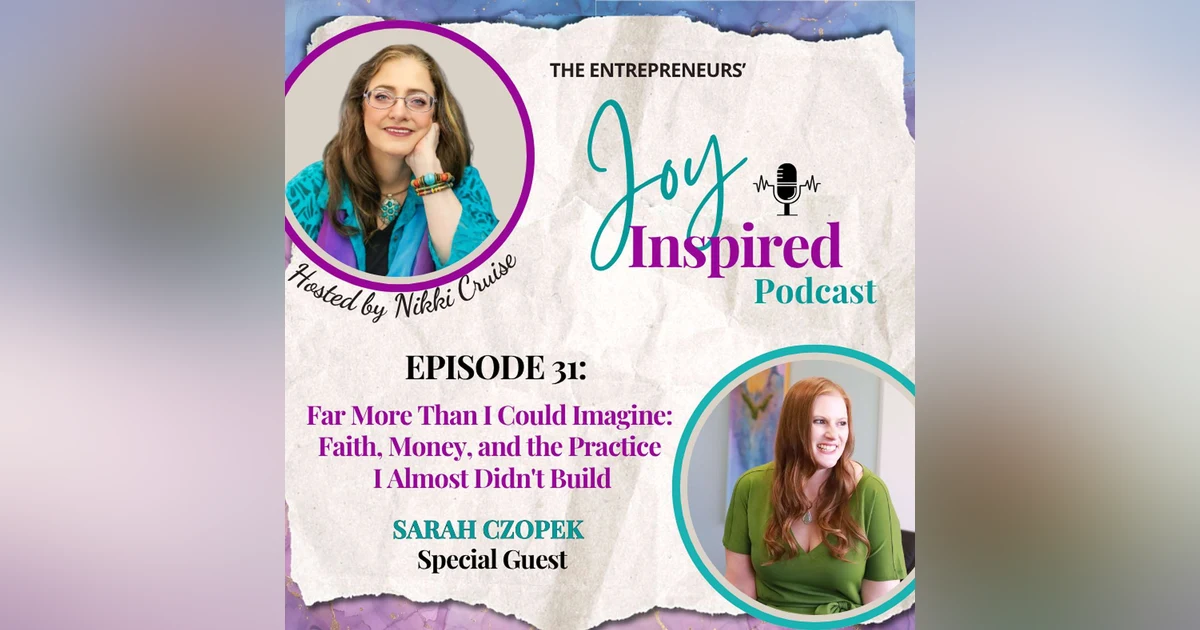
Episode Summary In this inspiring episode of the Joy Inspired Podcast, Nikki Cruise sits down with therapist, entrepreneur, and founder of Grace and Gratitude Counseling and Revenue Rich Therapist, Sarah Czopek, for a powerful conversation about faith, money, purpose, and building a business that brings joy instead of burnout. Sarah shares how she never planned to become an entrepreneur, yet God used every unexpected turn, from music and business school to counseling, to prepare her for the w...


 RSS Feed
 Episode Summary
In this inspiring episode of the Joy Inspired Podcast, Nikki Cruise sits down with therapist, entrepreneur, and founder of Grace and Gratitude Counseling and Revenue Rich Therapist, Sarah Czopek, for a powerful conversation about faith, money, purpose, and building a business that brings joy instead of burnout.
Sarah shares how she never planned to become an entrepreneur, yet God used every unexpected turn, from music and business school to counseling, to prepare her for the work she is doing today.
Together, Nikki and Sarah explore the importance of changing our beliefs around money, recognizing when success is costing us our joy, and understanding that financial growth and Kingdom impact can work together. Sarah shares how reaching six figures still left her burned out—and how that realization led her to build a group practice and eventually Revenue Rich Therapist.
Whether you're building a business, navigating a money mindset, or wondering if God has something bigger for you, this episode will encourage you to stop playing small, trust God's direction, and create a life and business that are truly sustainable.
Key Takeaways
- God can lead you somewhere far beyond what you originally imagined.
- Your past experiences may be preparing you for something you can't see yet.
- Faith often requires taking the next step before you know the whole plan.
- Money doesn't have to be something you fear or feel guilty about.
- Financial growth can create greater capacity for impact.
- Success isn't worth it if it costs you your health, family, and joy.
- A thriving business should support your life, not become your life.
- Sometimes you need to identify what you don't want before you can build what you do want.
- Delegation can create space for greater impact and sustainability.
- Faith and good stewardship belong together.
- Playing small can keep you from opportunities God has placed in front of you.
Scriptures
- Ephesians 3:20 - "Now to him who is able to do immeasurably more than all we ask or imagine."
- Proverbs 3:5–6 - "Trust in the Lord with all your heart and lean not on your own understanding."
- Jeremiah 29:11
- "For I know the plans I have for you," declares the Lord.
- Philippians 4:13
- "I can do all things through Christ who strengthens me."
Encouragements for Your Journey
- God may be preparing you for something you cannot see yet.
- You don't need the entire plan to take the next faithful step.
- Your business can be profitable and purposeful.
- Money is a tool that can increase your capacity to serve.
- You don't have to sacrifice your joy to achieve success.
- Being successful and being sustainable are not the same thing.
- Don't confuse burnout with dedication.
- Give yourself permission to imagine something bigger.
- Your experiences, including difficult ones can become wisdom you use to help others.
- Trust God, but steward well what He has already placed in your hands.
Root Check Questions to Reflect On
- Am I playing small because of fear disguised as humility?
- What might God be inviting me to imagine beyond what I currently see?
- What beliefs about money did I inherit that may no longer serve me?
- Is my business giving me freedom or quietly stealing my joy?
- Where am I experiencing burnout or striving?
- What do I need to stop doing so I can create a more sustainable life?
- Where is God asking me to step out in faith?
- Am I trusting God while also stewarding my finances wisely?
Connect With Sarah Czopek
Website: https://revenuerichtherapist.com/
Email: sarah.czopek@graceandgratitudecounseling.com
Facebook: https://www.facebook.com/graceandgratitudecounseling
LinkedIn: https://www.linkedin.com/in/sarahczopek/
Stay Connected with Nikki:
- Website: www.joyinspiredpodcast.com
- LinkedIn: @nikkijoyinspired
- Email: support@joy-inspired.com
Closing Encouragement:
“You were created for a unique purpose. When you invite God into your business, you step into a calling that impacts eternity. Remember, alignment doesn’t mean perfection—it’s a journey of trust, surrender, and joy.”
Until next time, stay blessed, stay joyful, and keep walking in your purpose!
Welcome to the Joy-Inspired Podcast. I'm Mickey Cruz, and I'm thrilled to explore with you what it means to walk in a faith-in-fused business. This is your space to find powerful tools and insight, to build with resilience, and to create impact through your unique purpose. Discovering a joy that only God can provide. Together, let's embrace a business journey anchored in faith and empowered by joy. Let's jump in. Well, hello, hello, hello, amazing people. Welcome back to another episode of the Joy Inspired Podcast. It's awesome to be back with you. And if you're wondering who is this crazy lady, my name is Nikki Cruz, often known as the Joy Junkie. I am your greatest cheerleader. I'm the one who wants to carry you along. I don't want to carry you because the victory is yours, but I want you to have joy in it. And I am super excited that even as we press into finding joy by aligning our faith, passion, and purpose, because we want to bring God into our businesses and have that alignment. That's where you find the joy. That's where you find the energy to get going. Keep going because I don't know. Joy is not just what you get at the end. Joy is what leads you through to the end. And I am super excited to introduce you to our guest today. Sarah Chope is just the most amazing, beautiful, spirited soul. And today's episode is called Far More Than I Could Imagine. You know why? Because so often we think God can only do what we imagine. So Sarah's story immediately resonated with me, and I've loved working with her on a previous summit. And she's the owner of Grace and Gratitude Consulting and the founder of Revenue Rich Therapist. She's built an incredible business helping therapists create sustainable practices. You know, and we don't often think what happens between us going into CD therapists. I visited a therapist, there is no shame in it. And I encourage you, if you feel like you need to, visit one. We get to get out of this stigma of shame. God created people with this knowledge and wisdom to share it with us. And with Sarah, he's taken that knowledge and wisdom one step further. You see, he wants therapists to create sustainable practices without having to deal with burning out, sacrificing their passion for their calling with their calling or sacrificing their time with their families. And Sarah has created an incredible impact financially in her life. But you know what? What really drew me to Sarah was her heart. You know, the application questions have kept bringing one theme back that God is capable of for far more than we imagine. And as you hear her talk, you will see that in her. You will see that in the grace that she shares things with. So Sarah, welcome to the Joy-Inspired Podcast.
SPEAKER_01Oh, thank you so much, Nikki. It is truly a joy for me to be here with you. And you are living out God's call for you. It's clear as day that this vibe of being everyone's encourager, everyone's cheerleader, you were made for it, you were born for it, and you're doing exactly what God's spiritual gifting is for you, what he has for you. And I just appreciate so much your energy and the work we've done together already. I'm excited to be here.
SPEAKER_00Well, thank you very much. And I want folks to get to know you a little before we start going into your story. So tell me, where in your life do you experience joy the most?
SPEAKER_01Oh well, that's a big question. Where in my life do I experience joy the most? A few places immediately come to mind, right? There's this exercise that we do in EMDR therapy called calm place, where you envision a memory, a place that you have felt the most calm in your life as something that you kind of build and resource so that you can return to that as a way to regulate. And when I built my calm place, it was it was around this moment when my children were small. This must have been pandemic days, like when I had just started my practice, and I just see in my mind walking along a path in a park near our home at the time with my then three-year-old and five-year-old, and we were walking along, and we were checking all of the milkweed for butterfly eggs of the monarch. And we were checking amongst the brush for wild black raspberries and mulberries and just kind of snacking on them. And I'm picturing not myself, I'm picturing my children. I can see them in my eyes, kind of foraging and looking and just marveling in God's creation, the things that He just put before us, right? So my children, nature, right, those are two huge sources of joy for me because they're some of the biggest blessings that have come in my life.
SPEAKER_00And I would have added to that um the berries and the food. The berries also, yes, yeah, and just color and fun and being outdoors. I that paints such a beautiful picture, it's almost a storybook picture.
SPEAKER_01And the warmth, you know, just warm outside, the sun, a beautiful day. Yeah, that's joy to me.
SPEAKER_00And I just learned right before this recording that Sarah raises butterflies. And you notice how she spoke about butterflies. And isn't that so beautiful? I love butterflies because of the representation of all of that transformation. And if I have a beautiful poem, one of these days I might share with you all about butterflies and the faith of a butterfly. And the fact that when it's sticky and icky and opening a cocoon, you don't realize it's going to be a beautiful butterfly. And faith is standing in that place where you see data in the future of it. And I think that's a lot of what I see in Sarah. She has a vision of something beautiful for other people. But you know, you mentioned something that you actually never intended to be an entrepreneur. Take us back to the beginning of that story.
SPEAKER_01Oh my goodness. No, I didn't intend to be a therapist even. And this was not ever a part of the journey that I thought that I would be living and leading. Um, but God does crazy amazing things. And um, you know, when when I was young, when I was in high school, and and prior to that, I was uh a vocalist and I sang and music was my world. I uh did competitive uh voice competitions and was first year and this and that and the other, whatever, right? And that's what I thought I was gonna do with my life. I thought I was gonna be a musician because it was the most obvious gift, right? It was the thing that you could see and hear, and that people applauded you for and kind of pushed you forward on. Oh, yeah, go do this, go do this. So, of course, I wound up going to university on a um music scholarship and starting to study vocal performance and vocal education. And um yeah, I could have had that life. That could have been the long-term life, but God had other plans. He had other plans. And in the summers, when I was not doing coursework, I had started to do youth ministry internships. And God said, mind you, I'd only been a Christian since 18, right? I kind of turned turned to the Lord at that time. God was saying, You have other gifts, you have other gifts that I have given you. The ability to connect with people, to make people feel comfortable, right? The ability to have wise discernment about um choices and things that people are doing. And all of that eventually led me, long story short, to turn to a master's in counseling after I had finished what wound up being a degree in uh music business. So I'm cutting out a little bit of the story there, but there was a, I guess I'll have to say it, I transferred at some point from my first university and uh wound up finishing out a bachelor's of business administration rather than the vocal performance education degree that I had set out to. And that was all by God's design, also, right? Because then I wound up with the core marketing classes, strategic management, accounting, you know, all of those core business classes that other therapists don't have. I didn't know at the time that I was gonna become a therapist, right? But I did wind up with this business degree. So when I got my master's in counseling, I thought, well, I'm just making a switch here to be a counselor. The business side never entered my brain again. It was just a degree that I got. I wasn't gonna use it. It was just, okay, I'm finishing this, and now I'm moving on to get my master's in counseling. I started out in a nonprofit therapeutic day school as a one-to-one aide in a classroom for children largely with autism, worked my way up into um their kind of parent educator position and their counseling positions there, which was really low pay, right? It was a nonprofit, so I was I was earning, I don't mind telling you, I was earning uh roughly 28 to 35,000 a year during the time that I was there, by the time that I left. And I stayed for several years thinking I am going to work towards the student loan forgiveness program that was a big thing, the public service student loan forgiveness plan. But what God showed me during that time that I was there is that yes, I was, yes, I was doing good in the world, yes, I was making an impact, and I was playing small. He had more for me. I began to have big ideas about things that we could do, um, other ways we could change programming, stuff that we could build. And I just got no's. No, no, no. We don't have the budget, we can't do that. That's not in your job description, you know, like all of those things. Yeah, yeah. And I started looking for what else? What else can I do then? What else can I do? Right. At some point, I did a brief stint in private practice. Once I got my full clinical licensure, I decided I'll go work for a group practice and I'll just do that on the side and see how it goes. And Nikki, I hated it. It was an awful experience because the practice that I worked for at that time seemed very focused not on making a difference, but in making money. It was about the billable hour, it was about filling up my schedule. Can you just work a few more hours? Go ahead and charge this CPT code and tack that on because it might be a little extra Starbucks money for you or a new pair of shoes. These are things that came out of the mouth of that practice owner. I lasted nine months and I said, if this is private practice, I don't want anything to do with it. This is not the game that I came here to play, right? So business was not on my mind. It was not on my mind at all. But fast forward a few more years after that, I'm still maxed out, capped out, not able to grow professionally, definitely not able to advance my career at all in the position that I was in. And I knew that I needed more. I couldn't sustain my life with now two very small children. Um, financially, uh, my husband and I needed me to be making more, and I just wasn't feeling aligned with the life that I was living. It was fine, but it was like skating by, and I'm not a skating by kind of person, right? Yeah. So I started researching what else can I do? And um actually I'm telling the long version of this story, Nikki. I hope that's okay. The long version.
SPEAKER_02That's nice.
SPEAKER_01So many questions going on in my head. Go for it. It just feels right to tell the long version. So we're doing it. Yeah. So I started thinking about what else I could do. And I picked up the phone, I called a former supervisor who was um doing some adjunct work and also in private practice, and I really wanted to ask her about teaching, right? And she said, No, why don't you come join our group practice? And I was like, uh, been there, done that, really not a thing that I want to do. And she proceeded to tell me all the ways that it would be different working for the practice that she was with. And I took a deep breath and I said, Okay, I will give that a shot. And because their practice was actually built correctly, they asked me to establish an LLC so that I could be paid appropriately as a 1099 contractor, which the other practice did not do correctly. So I um in February of 2020 established my business, which was just Cerotopec LLC at the time. And then, Nikki, I was so worried about not getting enough referrals when I made the switch to group practice because this practice was largely word of mouth. They didn't have any, you know, a good website or other referral systems. I was so nervous that I started researching that. How do I start building my own referrals? I created a website myself and just invested a few hundred dollars in building this website on Wix or Squarespace or whatever it was, um, so that I could refer clients into their group, right? You want to work with me? Go here and book it. I wasn't planning to book them myself, um, but I built the website. I was a little worried they weren't gonna give me enough referrals still, so I joined one of those online telehealth companies that now I tell everyone to run screaming from. But at the time, that seemed like a good idea. I won't name which one, but I joined it and had some clients going through there and learned how to do telehealth because of that. All of this before the world shut down on March 13th, 2020. Okay.
SPEAKER_00Wow.
SPEAKER_01Do you see what God is doing? Do you see it? Right? He positioned me. I did not go looking for that opportunity, and it was my own drive that he gave me, and um, you know, worry about what could happen that caused me to go research these other things, and it perfectly primed me to be able to open my own doors when the pandemic hit. So that's kind of what happened. I did work for that group practice for a time, and because I had already figured out how to do telehealth, I'd already set up a website and I'd already learned how to do some marketing. I thought, well, I may as well just try and get some of my own clients over here on the side and see how that goes. And it went. It went. About nine months passed from there, and I was able at that time to say to the group practice, thank you, but I think I'm gonna go do this on my own. I think this, I think I'm called to do more, right? The practice owner, also a Christian, lovely, lovely human, uh, came back to me and said, I'm really sorry to hear this. Is there anything we can do to to convince you to stay? And I just said no, right? Because I really think that this is what I'm supposed to do. I I'm enjoying doing this sort of on my own and being the owner of this thing and and watching it grow and build. And I want it, I want to do it. I don't know exactly what God's doing, but he's doing a thing here, and I'm gonna trust it.
SPEAKER_00So I pulled I think that's so important. You know, so often we know God's pulling us, but because we don't see the whole picture, and because it doesn't necessarily make sense, we don't step out in faith. When you hear God or feel God calling you or nudging you in a direction, it often doesn't make sense at the time. And if you stop and you look back, just like Clara's now looking back, I see it. I see it so clearly. He was drawing out now. A lot of people say, why doesn't God just give me the whole plan? I believe God doesn't give us the whole plan. It's because if we have the whole picture, we start building it ourselves. We take control, we take it out of his hands. But there was another thing there that Sarah left that practice and you know, she was saying, Yeah, you know, this isn't what I bought into. But it doesn't mean her passion had changed or her purpose had changed. The way it was being released into the world was not right for her. And God sees that. God knows exactly where he wants you, and none of that was a mistake, it was all for growth. And I just love looking at stories like that in retrospect, Sarah. And you know, what was it like before you started on your own? What were the good things, what were the bad, bad things before you actually started your own practice?
SPEAKER_01Yeah, I think a lot of it was scary. And I mean, for heaven's sakes, we're talking quarantine time, so there was scary on top of scary, right? Uh stuff going on in the world at that time. But um, you know, I I had to have a lot of trust in myself as well as in what God was doing. And I I agree, you have to let him build it. He sent me the right people at the right times for that. And he even used my own panic, my own fear and worry as an instrument of his his provision, right? Like he in my worry, he provided for me a website, right? Like if I hadn't been worried, I would not have done that. I would not have signed on to one of those telehealth companies and figured out how to do telehealth if I had not been worried. So he even used my worry because he knows my heart and he knows that's what I needed. That experience that I had that was negative in private practice, I had no idea that several years later I'd be building a group practice. But he used that experience to inform me of what not to do, how not to be, right? And so when I uh later on spent spent a year or so building up my solo practice after leaving that other group um and started looking at hiring people, I had a vision of of what I didn't want to do and who who and what I wanted to build instead. And I I wouldn't have had that if if he hadn't given me that negative experience earlier.
SPEAKER_00Yeah. That not knowing what you don't want, I believe is as important as knowing what you do want. And as entrepreneurs, we very often don't take the time to say, this is what is not acceptable to me with clients, with practices and everything else. And at the same time, you were going through there and you uh you were obviously aware you say the money was coming in, but it was just okay, and you were made for more. Now I know your heart. So I know exactly where you're coming from. But for so many people, the minute we mention the word money, what happens? And I know the crazy. Yeah. And money mindset is so important. Money mindset, you know, um, I think uh Clarice Flewett who said she had a dog called um billings or bills, and she used to call him. And they just say, Come here, bills, come here, bills, and then roll over bills, roll over bills, and it was like a declaration of let the money come in. We've got to believe that it's okay before we can take another step, because God did not want us to live in poverty. And when we do live just getting by and we can't celebrate life, doesn't look so good on our Father God, on the King who wants to lavish us with everything. So before we even go into this next question, I just wanted to put that out there.
unknownOkay.
SPEAKER_00If you are thinking. It is not okay for you to make money in your business. You do not have a business. You have a hobby or you have a ministry. And I stick to my statement. God did not say I go about my father's. I mean, Jesus didn't say I go about my father's ministry. He said, I go about my father's business. So even in a ministry, it is vital that you are bringing in enough income that you can support yourself, that you can progress in that ministry. Why should we serve people and be struggling? Because then we're pouring not only out of an unfilled cup, but a cup with a crack in it. And I know that you, you know, behind the scenes, there's been a lot that's happened in your life relating to money. How were you brought up thinking about money, Sarah?
SPEAKER_01Oh, money was scarce. And I grew up, I guess I would describe it as riding the poverty line. I would not say that we were poor because I know there are definitions of poor that are much stronger than than we were. But I grew up in a paycheck-to-paycheck household where looking at people who had money was sort of done through a lens of judgment, right? Right. Um, that those people were were yuppies or um, you know, preppy or or whatever, those are sling terms from the 90s, of course. But yeah, that's how it was looked at. And the attitudes were um about getting by, you know, we had in I was always clothed, I was always fed, you know, we're not we're not saying anything nefarious in terms of of neglect. Um, but we we couldn't do anything extra, right? Going out to eat was something that you only did for someone's birthday. We didn't run through, run through Panera for some iced tea, right? Um, that was getting a drink at a restaurant was, oh, I'm gonna get a drink too. The drink cost two dollars. I don't know, right? It was that kind of attitude. Um and um there were things that I had to say no to in terms of extracurriculars and going on school trips and things of that nature just because the money was not there. And um, you know, my family had a little bit of pride about that, and you don't ask for help, right? You you just figure it out or you go without or that kind of thing. And there was a period in high school where things got a little bit tighter just due to some family changes, and I wound up eating meals at friends' houses a lot of the time because the money wasn't there, or um, you know, needing needing other support system folks in my life to help me get things that I needed, like socks from Target, right? That's something that I talk about sometimes. Um yeah, so that was that was what money was growing up. It just it wasn't a thing that we had none of, it just wasn't a thing that we had a lot of. And the people that did have a lot of it, you kind of looked at them like it was uh like it was a negative, right?
SPEAKER_00Yeah. And I mean, obviously, you're growing up with this, this is just the norm. This is you think everybody has the same view of money, that it is not freely available. And those who have it, I don't know, it might be termed various, still gotten gains, you know, if they got money. And it sets you up to think about things in a certain way. And yet you went forward and looked and said, hang on, I've got enough money here, but this isn't the life I want to live. I would like to, I don't know that if this is true of you, but I would like to go out for meals whenever I feel like it and have that family folk, freedom, the joyful freedom of choice. You know, it's not that money buys you happiness, but money does bring freedom. So what happened to shift that view for you that money was scarce or not freely available, to saying, money's available if I want to work for it, and it is mine if I want it.
SPEAKER_01Sure. Yeah, that was a very tough lesson for me to learn. And I will say some days I still feel like I'm learning it because the um uh financial fears are so deeply rooted, I get panicky about money still, even though I have enough now. Um, and have more importantly, the skill set to acquire more if I need it, right? Um, but what shifted, I think it just happened gradually over time. And recognizing that I do have skills that God has given me and skills that I have worked hard to cultivate within myself that translate into the ability to make money, right? I started seeing the practice fill, and the the end of my first full year in solo practice, I was staring down at a hundred thousand dollar profit. And the idea of making six figures, Nikki, that to me, all my life growing up, and even you know, in those early years was the holy grail of income. Like I could not fathom making six figures. That number just seemed astronomical to me. And I had to face it and go, I did that, and I can do more. Oh my gosh. And now I did that and I can help other people do more, right? It just kind of has kept kept growing into this larger message. Uh, but I don't think it's a mindset shift that is like a light switch where you can turn on and off. It happened in the smaller moments and then in realizing that, oh, we can afford to go on this vacation. Now, my husband has also had a lot to do with this, and we grew up in very different family cultures. He was more middle class, upper middle class than I was by by a long stretch, um, but certainly not growing up wealthy either. However, he is uh by trade a financial advisor, he's a wealth management advisor, so that's what he does. So he's in the money stuff day in and day out with people, and he has a much more even-keeled perception on what money is and what it can do. And in the early days of my business, he was growing in his income as well, working for another financial advisor. We've since kind of flip-flopped. Uh, he may not love me airing all this out. I won't give numbers, but we've since kind of flip-flopped because he dropped that and started building up his own book of business, right? When I started getting more successful. But anyway, at the time, at the time, he was making substantially more than I ever dreamed that we could make. And I just remember um when the kids were young, um us booking, I think it was just before the pandemic hit. So this would be maybe six or eight months before I started the practice. Uh I remember booking a trip to the Wisconsin Dells, and it cost $500 for the two nights that we spent at this indoor water park, magical land that our toddlers were gonna love, right? And I just remember kind of looking at like, are you sure I can hit the book button? Like we can spend five hundred, we can spend five hundred dollars on a two-night. Are you sure? Like I was so panicked about it. And that moment I think was pivotal, just clicking it and going, the sky didn't fall. We can still buy groceries, there is still guest money, right? I still can put socks on my children's feet, and we're going on a $500 two-night vacation. We're doing that, right? And these moments just happen more, and not the vacations necessarily, but just the ability to say yes to things happen more. And every time it was this internal, it's some sort of nervous system thing that happens within me, right? That kind of sensation of panic and shutdown and freeze and all those things that then would settle and be soothed by recognizing that the sky didn't fall, right? And that that it was okay. And there's there's still more money. We if we need it, we can we can figure out how to make it happen, right?
SPEAKER_00And and that's that's huge. It's that it is incremental. It is the what's been ingrained into your belief system has happened over years. Yes, it is a choice and a decision to believe differently, but you have to put that belief into practice. So for those of you who love my fancy word neuroplasticity, it can then rewire those pathways in your brain. You report six figures and you did it really quickly. And then you found that there was something else that was challenging you because you then the burnout mode. And when we talk about joyful entrepreneurs, this is one of the biggest things. We run into this business that we're gonna make so that we can have freedom and we become slaves to our business. And I loved your one comment, which relates to therapists, but it's true of entrepreneurs. A burnt-out therapist doesn't change lives, but a thriving one does. That's right. And that launched a whole new world and thought for you. Tell us about it.
SPEAKER_01Yes, yes, I would love to tell you about that. Yeah, because there was this journey, right? Of filling up my solo practice and accomplishing six figures. And I was kind of miserable because I was seeing 25, 27 clients a week. My kids are little and hanging around my ankles and hanging off a screen side raise while they're trying to do e-learning and all kinds of stuff during that year. It was bananas, and I knew that even though I was making good money, that life wasn't sustainable. And um, I didn't really want to stop doing it either, right? There was something magical about unlocking the skill set that I had realized, okay, I can confidently move into this. So I started to grow a group, a group practice, and that's when Sarah Chobuk LLC changed into Grace and Gratitude Counseling, my core group practice, which I spent the several the last several years building and creating an amazing space that incorporates um several uh Christian faith-based therapists as well as uh other clinicians. Uh, we use deep healing modalities like EMDR and IFS. If you don't know what those are, go look them up. They're amazing. And we now serve a multitude of women versus the 25 that I could have seen on my own. Um, and as I have grown that practice, I have continued learning as an entrepreneur, as a business person. I have continued building relationships and networking within the therapist community and hearing what other people are struggling with. I started supervising clinicians, and it led to me recognizing that I now have a new skill set that I can help people with. Not just the skill set of being a counselor or even just of building a solo practice and making that happen for me, but a skill set of teaching, of teaching other people how to accomplish the same kinds of dreams, the same kinds of impact. And that is how revenue rich therapist was born.
SPEAKER_00And that's beautiful. And you know business takes work, so it doesn't mean you sit there and you say, Oh, I'm going to have joy and everything will fall into place. I want to stay here for a moment because this is such an important conversation. How do we know the difference between healthy sacrifice and building a business that's quietly stealing our joy?
SPEAKER_01Yeah, I think it's I think it's in the margins, right? I think it's in the margins where you have uh um the the day-to-day that you are walking through life with, all of the tasks that you have to do, the core business things, you're getting that stuff done. And then there's these quiet moments, right? There's these um after you put the kids to bed and you're squeezing in a little bit of work, or you know, the between calls moments or the first thing in the morning, right? These margins. And if in those margins you are stressed out, you are panicking, you are worrying, then something needs to change. If in those margins you are amped up, you are excited, you are passionate, you are fueled, then something is working, right? Something is bringing you joy out of that work. And then it doesn't matter if you're working 20 hours a week or 80 hours a week, if it's bringing you joy, great, great, you can do that, right?
SPEAKER_00Absolutely. And now you help other people, other therapists in particular, build multiple income streams. But underneath that, you're actually really helping them build something else. What is that? Yeah, and helping them build sustainable lives, right? Absolutely. The confidence and the peace where they are not slaves to their businesses. And that's a lesson we can all learn because it doesn't seem to matter how much we know this, we continually seem to have a step back into that striving. And I think that's where our alignment gets to be taken regularly. And what is going to tell you that you're out of alignment, folks? If this is your first time watching this podcast, you won't know the answer. If it's not, you should or could. And that is if your joy isn't there, it's telling you that you are misaligned. So if somebody listening today feels trapped in their business, where should they begin, Sarah?
SPEAKER_01So they should begin by examining. Um let me pause that. You can edit that part. Let me think about that for a second. Where should they begin? I mean, we can call that a joy audit, Nikki, really, right? Taking a good hard look at the business that you're in and the life that you're living, and how close are you to actually experiencing the amount of joy that you want in your life? There's a modality called Act that talks a lot about um our life values and the life you want to build, and every action that you take and every decision you make, either moving you further towards that life or further away from it. There's no middle, there's no like neutral ground. Anything that you do is either gonna cause you to stay stuck or or degrade or to move more towards this life that you want to live. So you need to audit yourself, right? Examine where it is that you could make changes. One of the ways that I teach about that is to encourage people not to play small, right? To recognize that God may have something outside the box for you. Maybe your joy is being stolen because you're not open enough to the creative ways that God can design your business or your life or reach your clients or sell that product or whatever it is that you are doing. And so we notice all the ways that we can open ourselves up to a bigger idea, a bigger design with his help.
SPEAKER_00Absolutely. And you have a saying about imagining small. Tell us about it. Do you know which one I'm talking about? I don't think I do. Okay, you say, and you wrote something that really stopped me. Imagining small isn't humility. It's something we're dressed up as modesty. And it's such a faith-centered thing that we do when we're afraid, we dress it up as something else. And you know what? That doesn't honor you, it doesn't honor God. And if you have something bigger inside you, it's a time to release it to the world. And if you're feeling burnt out and weary and worn, I totally agree with Sarah. Do that joy order because it is out of alignment. And very often you will find that your business has become your life. Your business is a part of your life. You cannot separate the two, but your business shouldn't be your life. God gave us more than that. And I love that what you said there. Now, Sarah, you have so much wisdom. I could spend hours talking to you here. But tell me, when has God surprised you the most?
SPEAKER_01Honestly, I think that he surprised me the most in this recent endeavor to launch revenue-rich therapist. I certainly never thought that I was going to be a practice owner at all. I definitely didn't think I was going to be a group practice owner. I never in a million years thought that I would be coaching other therapists how to be more effective practice owners and to grow their income and impact on the world. Um, but but somebody said something to me at one point that just made a lot of sense about um recognizing the journey that you've been on and what a gift that it can be to help other people to do that uh as well, and that being an opportunity, right? An opportunity for me as well as an opportunity for everybody who I can share this wisdom with. And that surprised me. I just didn't see it coming, but now that it is here, it again just feels like all the pieces are falling into place, right?
SPEAKER_00And every step of the way it took faith. It took a bit of faith. And there's one really big faith story. I'd love you to tell the story about hiring someone before you could really afford it.
SPEAKER_01Yeah, yeah. So um that particular story is about my sales and operations manager for Grace and Gratitude counseling, my core court group practice. And I had just come to a point where I knew that I needed more uh operational support and somebody whose job it was going to really be to do a lot of the referral building and marketing as well as look for ways to make the practice more efficient. Because when you are a practice owner, I mean, I will warn you out there if you're considering uh going into that, you you really are doing all the things for for a while and you have to slowly delegate and um kind of offboard certain tasks as you can. And so it was making a lot of sense at the time for me to find a person who would be in charge of those things. And so I went looking for this person while also kind of eyeballing my finances and the business, and things were pretty good, right? Things were pretty good, but then I lost a couple of clinicians. Then the plan that I had to kind of grow things a little bit, adding in more clinicians, the building of referrals didn't go as fast as I wanted. This position that I was bringing in was non-revenue generating, it was a managerial position and not somebody who was out there seeing clients and bringing in money. Um, so all of the um the salary that I was paying for this person was essentially just coming from the profit of the business, which you know rapidly shrunk as a result. Uh so it was a hard time and a hard lesson, I think, in recognizing that you can step out in faith and do something. And at the same time, you really need to be paying very close attention to your financials and and have those um backup plans in place. Thankfully, um, it became another opportunity for me to learn and to grow and to build on that financial freedom skill set, which is having the the skills that you need to make money happen when you need it. And it was during that period that um I had an 11-week stint in which I generated an additional $41,000 in beyond the one-to-one client income because I had to, because I needed to, right? I needed to do that, so I figured out how to do that. So sometimes you know, you make mistakes or you have hiccups, and God uses that as a way to teach you that you're capable of far more than you could ever have imagined. Yeah. Because He is capable of far more than you are capable of thinking.
SPEAKER_00Yeah, and you said something there that's so important. You know, just because you have faith, it doesn't take away the need to steward well what God has given you. Yeah. Stewardship.
SPEAKER_01I could have done I could have done a better job of that at that time, and I fully recognize that. Um, and I think it was a valuable experience.
SPEAKER_00Absolutely, absolutely. But you don't sit back and say, okay, I've got faith, it's all gonna work. You make sure that you put plans in place. And folks, I think you've seen a lot of Sarah's heart chat. Do you see why I'm so passionate about what she does? Because it does align faith, passion, and purpose. It does bring joy. And she has very kindly got a gift for us. Now, for those of you who might be listening driving, you don't need to let go of the steering wheel and start scrambling for a pen and paper. It is in the comments and the notes. So it is there for you. But Sarah, won't you tell us about the gift you've got for our audience?
SPEAKER_01Yeah, this gift in particular is for private practice owners, whether solo or group. It also applies if you are a coach, like a life coach or a healer of some kind, seeing clients one-to-one. And it's called the cost of playing small calculator. Essentially, it helps you to figure out how much money you're leaving on the table when you play small, when you are not going after with confidence and with faith that other idea, that intensive or retreat or program or expansion, right? What could you be earning? How much bigger could your impact be if you were to go for that? Right. So it's going to spit out a series of numbers like your true hourly rate, which is probably lower than you think once you count all those invisible hours that you might be working. It's going to tell you your income ceiling, what you could be earning annually, and uh and also kind of what tasks you can delegate, because you're going to learn the number that makes sense, right, to delegate. So somebody is is um someone you can hire for a fraction of the cost of what you could be out there earning. It's gonna tell you that number so you know what you could be doing to grow your business right now, right?
SPEAKER_00That is that is a powerful tool, folks, because most of us heart-centered coaches go in with all the emotion. There is a very practical side to all of this. And the more money you've got, the more people you can help. Money is not a dirty word. Money is not the root of all evil. The love and elevation of money is what causes us to sin and fall. Money is simply a tool God has given us. And He doesn't want you to be living in lack. He doesn't want you to burn out trying to live out your passion. He wants you to be walking it in joy. Sarah, with everything you've shared here today, what is the one thing you would like our listeners to take home at the end of this episode?
SPEAKER_01Yeah. I want you to take home the knowledge that income and impact are not enemies. And I want you to take home the idea that you can trust that God will determine your steps, right? That He has a plan for you and you don't actually have to know it to embark upon it.
unknownYeah.
SPEAKER_00Yes. Oh, I love that. I love that. So, folks, if you've loved this conversation, because I think it really reminds us that God never asks us to choose between being fruitful and flourishing. God wants both for us. And sometimes we believe that serving well means living exhausted. Where we came up with that opinion, I have no idea. We've watched other people do it. We believe success has to cost us our joy. Let's throw that out the window. Throw it out there. The joy of the Lord is your strength. But it comes with wisdom and putting practical situations, practical systems into place. And this is part of what Sarah's talking about. So please be sure to connect with Sarah. Those details are also all in the show notes below. But what Sarah said about today is that sustainability isn't selfish. Yes. It's less selfish than trying to burn yourself out or trying to be sustainable and just not being able to do anything. It actually allows us to serve for the long term. So I want to leave you with this thought today. Ephesians 3, 20. Go look it up. Perhaps we've been asking God for enough instead of asking for immeasurable from him, immeasurable ideas, immeasurable provision, immeasurable compassion, love, forgiveness, everything. There is no limit to God. And doesn't isn't it exciting when you step into that? So if this episode resonated with you today and you think there's somebody who should share it, please be sure to share it. And don't forget to like it and leave a comment. And until we see you next week, continue to walk in joy. Sarah, thank you so much for sharing your wisdom, your honesty, your journey, and your heart with us today. And to everybody, blessings and having a joy-filled week. Thank you so much for joining me on the Joy Inspired Podcast at www.joinspiredpodcast.com. Make sure you hit that subscribe button so that you can get this and every other episode that comes out. We have lots of great stuff coming, and you don't want to miss it. So make sure to hit that subscribe. I am so grateful for all the reviews and comments, and I look forward to serving you in next week's episode.